
Crofton Directory Collection Holdings
Crofton has no directory run of its own. It is an unincorporated CDP and planned community. So the historical shelf is mostly Annapolis and Anne Arundel County material. The county business section of the 1887 Maryland Directory and State Gazetteer supplies useful county context. Annapolis volumes need a coverage check first. Only then apply one to a Crofton household. The Maryland State Archives collection descriptions keep the publisher and year distinctions that make such a check possible.
| Collection | Years | Where Held | Access |
|---|---|---|---|
| Maryland Directory and State Gazetteer, Bland, Baltimore Publishing Co. | 1887 | Maryland State Archives, SC 2140 | Reference and special-collection route; county business context |
| Annapolis City Directory, Gould & Halleron | 1896-1897, 1910 | MSA SC 2140; 1896-97 original noted at USNA Nimitz Library | Request or visit; the 1910 volume is digitized |
| Annapolis telephone directories | 1909, 1932, 1936-37, 1947-48 | MSA SC 2140 | Collection access; subscriber evidence, not a household roster |
| Classified Buyer's Guide and Polk's Annapolis City Directory | 1924-1925 guide; 1924 directory | MSA SC 4557 and SC 2140 | Digitized 1924 pages plus collection or film access |
| Polk's Annapolis (Maryland) Directory | 1928-1929 | MSA SC 4369 Trott Collection, microfilm M 11538 | Microfilm or collection route; coverage must be confirmed |
| Alphabetical Directory of the City of Annapolis and Polk's Annapolis City Directory | 1934, 1939 | MSA SC 2140; Trott Collection notes the 1934 item | Special collection, microfilm, or reference request |
| Polk's Annapolis Directory | 1972 | MSA reference A-4-4 | Library reference item; verify geographic scope |
No title proves Crofton households were covered. Each volume's city, exchange, neighborhood, and date is evidence. A label alone never reaches every current Crofton address.
Crofton Directory Geography
Anne Arundel County predates modern Crofton. Annapolis serves as the county seat. Older land records and local histories may describe the same ground as a tract, farm, patent, plantation, or lot instead of a subdivision street. The county's Region 5 Plan calls the Crofton Triangle a planned community established in 1964. That year works as a dividing line. Material from before it reads as county or Annapolis context, while later research can add the Crofton community name, development, postal city, and neighborhood.
The distinction is practical, not just historical. A Crofton mailing address can sit in overlapping postal, CDP, civic-district, and county planning geographies. Record both Crofton and Anne Arundel County in any research note. Then state what the source truly covers: Annapolis, the county, a telephone exchange, or a named neighborhood. Geography matters more than the street. A street match without it can join the wrong household.
Crofton Directory Research at AACPL
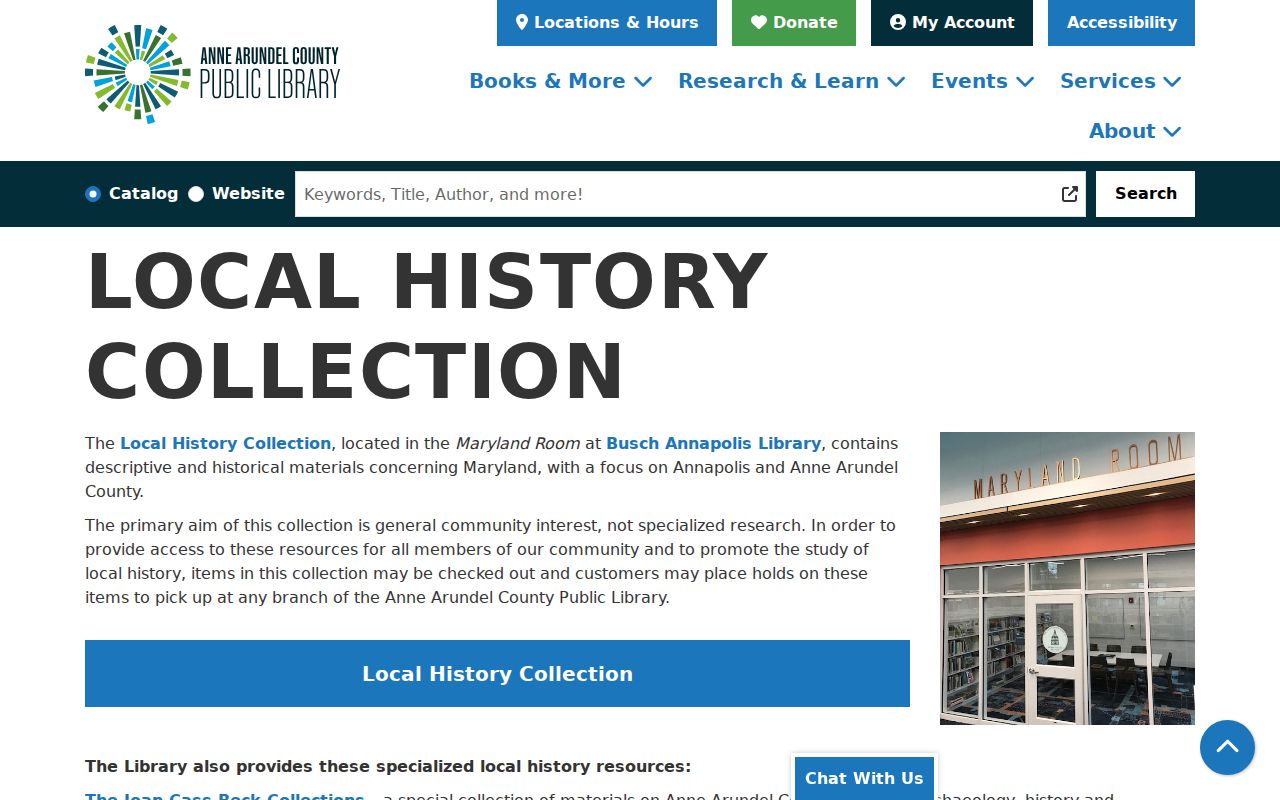
The Anne Arundel County Public Library Local History Collection is the first library stop for county books, maps, and local publications. Its Maryland Room sits at Busch Annapolis Library. Maryland, Annapolis, and the county are its focus. Items can be requested for branch pickup. The nearby Crofton Branch adds public computers, copying, scanning, and librarian referral. That helps when a directory scan, database, or catalog record needs a closer look.
The Local History Collection also points researchers to the Joan Cass Beck Collections and the Kuethe Historical & Genealogical Research Center. Beck holds more than 1,500 books and items. Journals, audio-visual material, maps, photographs, genealogical resources, and county historic-site files round out the collection. Its research libraries operate at Historic London Town and the Office of Planning and Zoning Cultural Resources Division. Both use an appointment route. Plan ahead for that. AACPL's genealogy resources separate in-library access for Ancestry Library Edition from other databases. Access labels deserve a check at use. The AACPL Local History Collection page shows the Maryland Room and its connected research collections.
That library route matters when a Crofton search hits a non-digitized volume, a county publication, or a local-history reference needing staff or catalog help. Some material never left the shelf. Ask before assuming a database holds it.
Note: Historical newspaper, census, and genealogy databases carry changing access labels, so confirm the library-card or in-library condition before relying on a result.
Crofton Digitized Directory Pages
The Maryland State Archives has digitized the 1910 and 1924 Annapolis volumes as Archives of Maryland pages with OCR and page images. Start with the State Archives directory guide. It lays out the collection geography and holding details. That prevents mistaking one readable page for a complete Crofton run. The 1910 directory is searchable by name or street. The archive itself warns that OCR can carry numerical errors, so treat the text layer as a lead rather than a quote. The 1910 Annapolis City Directory page 47 demonstrates the OCR-plus-scan route.
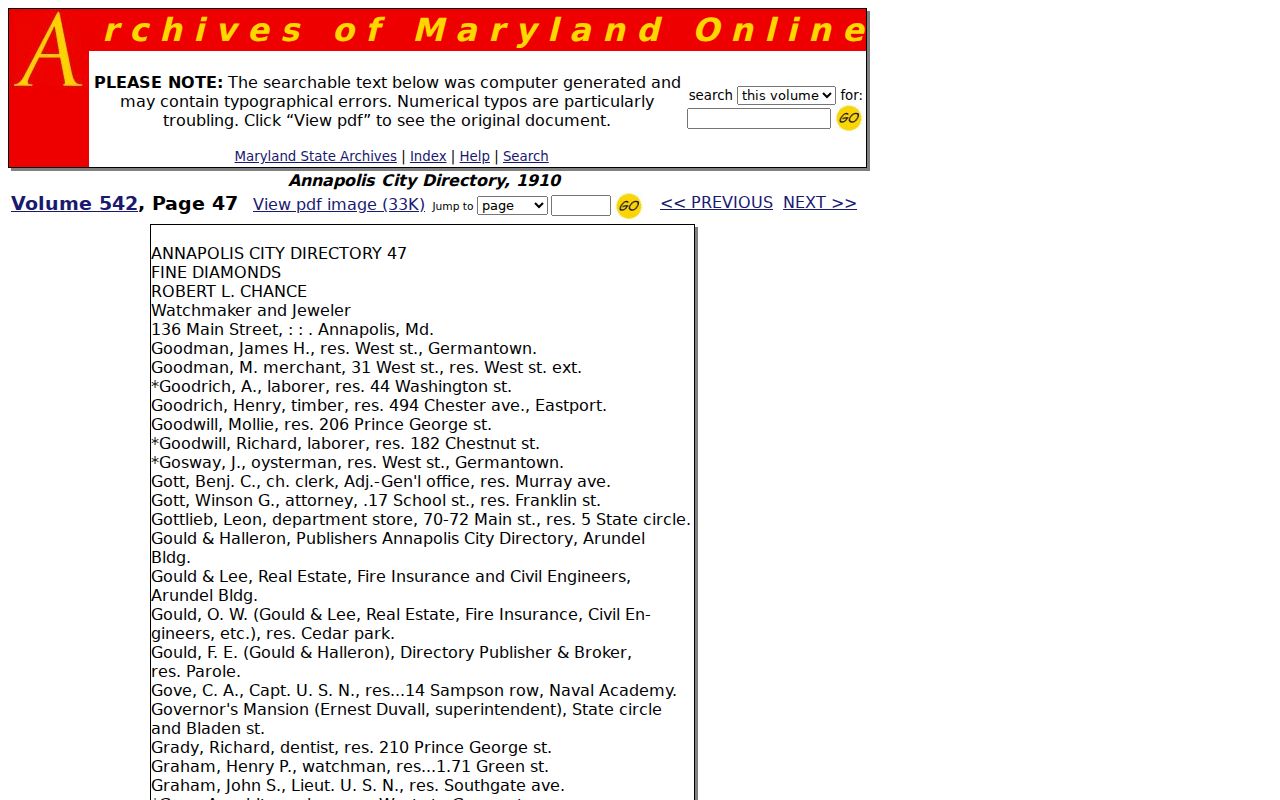
Trust the scan for a hard-to-read name or number. The text layer merely points to the right page.
Reading a Crofton City Directory Entry
A historical city directory entry packs evidence into one line. The 1910 Annapolis page shows a surname and given name or initial, an occupation or business, the abbreviation res. for residence, and a street, neighborhood, or number where supplied. Some entries add a spouse or household relationship. The 1924 Polk page has its own style. It adds occupation and spouse abbreviations, residence marks such as h or r, and a business address. These are Annapolis examples, not Crofton residents.
| Name | Surname plus given name or initial identifies the indexed person or business contact. |
|---|---|
| Occupation or business | Work or business wording can separate same-name people and point to a second source. |
| Residence | res., h, or r signals residence notation, subject to that volume's abbreviation key. |
| Street or neighborhood | A street name, neighborhood, or numeric address locates the entry within the printed coverage. |
| Household clue | A spouse, relationship, business owner detail, or telephone detail may appear, but not in every entry. |
- Criss-cross directory
- A reverse directory arranged by street and address to identify a listed occupant or subscriber. No Crofton-specific run was located.
- Householder index
- An alphabetical list keyed to the principal household name rather than every person connected to the address.
- Abbreviation key
- The volume's explanation of marks such as residence or business notation. Photograph or transcribe it before interpreting entries.
- OCR
- Machine-read text from a scan. It speeds a search but can misread letters and numbers, so the page image remains essential.
Read the front matter first. Before assigning meaning to a mark or initial, check the volume's own key, since the 1910 page's asterisk convention and historical racial labeling belong to that original context. Do not repeat them as present-day identity facts. A careful transcription keeps period language separate from the modern research note.
Crofton Directory OCR Checks
A stray digit can wreck a search. Whenever a number, initial, or street spelling affects a conclusion, read the directory image itself. The 1910 page shows a name, an occupation, a residence notation, and a location. The Archives page warns about OCR typos. One wrong digit changes the block. A misread abbreviation breeds a false match. Keep the page URL, the printed page number, and a transcription of the original wording in your notes.
Variants help without changing the source. Try the surname alone, initials, a spouse name, or a household name. Abbreviated suffixes and neighborhood labels help too. A missing result does not prove a move or death. The person may be unlisted, the book may follow a different coverage rule, or the OCR may have skipped the entry.
Note: Telephone directories list subscribers and principal contacts, so they should not be read as a complete roster of everyone at an address.
Crofton Directory Companions at Kuethe
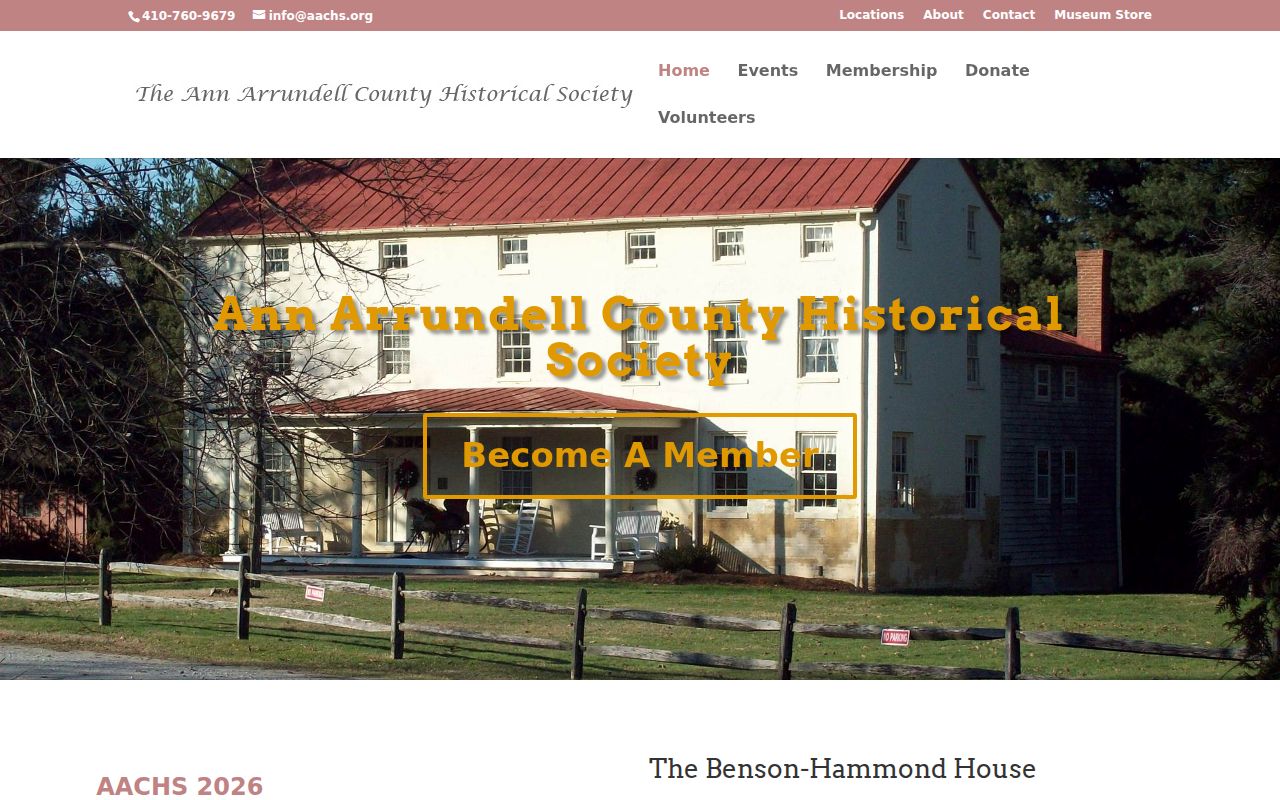
A directory match opens doors at the Kuethe Library. The Ann Arrundell County Historical Society keeps a strong companion collection there. The Anne Arundel Genealogical Society does too. The library holds more than 6,000 AAGS volumes. Maps, photographs, CDs, and obituary files fill the shelves. Bible and church records, plus subject files, round them out. AAGS separately notes county newspaper obituaries after 1985. Wedding or anniversary announcements from The Capital begin in 1988. Public access carries a small fee, and hours should be confirmed before a visit.
The historical society's collection page makes a sensible starting point. It frames the Kuethe route and its local-history context.
A directory entry is a start. Obituary, church, Bible, photograph, and map files can extend a former-resident trail once a name or address surfaces. AACPL lists Newspaper Archive, The Capital, America’s News, and ProQuest among its newspaper resources, with coverage and login terms to check at the time of use. An obituary is historical evidence. Match the notice against a custodian record.
Tracing Crofton Directory Households
Begin with the clearest item. Then build a dated trail. For post-1964 Crofton work, preserve the exact number, street spelling, postal city, ZIP, and development or neighborhood label for the household before checking later Polk, telephone, or reference holdings. A city directory names a principal resident or subscriber. SDAT and the deed index remain the stronger sources for parcel and ownership questions. The modern address chain continues in the Crofton Street Directory.
- Find the earliest relevant name or address in a source whose printed geographic coverage fits the question.
- Copy the entry exactly, including initials, occupation, abbreviation, street form, and printed page number.
- Search adjacent directory years and record every address or occupation change instead of assuming the first match is continuous.
- Pair a directory year with the closest released federal census schedule. AACPL's HeritageQuest route supports U.S. Census records from 1790 through 1930.
- Use obituary files, church or Bible records, newspapers, probate, and land records to explain a disappearance, move, or household change.
Federal census schedules follow the 72-year release rule. So the 2020 census is not yet public. Keep secondary items, like a newspaper notice or a directory entry, distinct from official deeds, court files, and vital records. That separation lets another researcher repeat the trail.
Crofton Directory Collection Timeline
The listed titles form a patchwork shelf. Crofton never got one continuous directory series. The sequence records only located years and milestones, without filling missing years with assumed editions or treating an Annapolis title as county-wide proof.
- 1887: the Bland, Baltimore Publishing Co. Maryland Directory and State Gazetteer supplies an Anne Arundel County business section.
- 1896-1897 and 1910: Annapolis City Directory holdings appear in MSA SC 2140, with the 1910 volume digitized.
- 1909 through 1947-1948: listed Annapolis telephone books offer separate subscriber evidence in selected years.
- 1924 through 1939: Polk, classified-guide, alphabetical, and Annapolis directory holdings continue through the listed 1924, 1928-1929, 1934, and 1939 editions.
- 1964 and 1972: Crofton’s planned-community era begins in 1964, while a Polk's Annapolis Directory is listed for 1972 as reference item A-4-4.
The 1964 date matters. Older records may use land and county names instead. The date also sharpens a collection request: ask for the directory's stated area and date, not a volume assumed to be a citywide Crofton roster.
Crofton Directory Gaps and Limits
Some gaps simply exist. Crofton has no public cemetery interment search, funeral-home-only archive, school-yearbook index, digitized newsletter archive, or reverse directory. The Crofton Civic Association wants old newsletters to scan. That is a future lead, not an index yet. AACPL, Kuethe, and the Library of Congress are sensible places to ask about Annapolis-area criss-cross or telephone volumes that a basic online search may not describe.
A printed trail can still end. The Maryland State Archives supplies historical county indexes, maps, and special collections. AACPL can route a researcher through catalog holdings and database access. The Anne Arundel Circuit Court Clerk handles official land and court records. A blank web image does not prove destruction. The record may sit on microfilm, behind a counter, or outside a digitization project. It may simply require an appointment.